
Aphantasia as a Writer

I decided that this week, I would write a bit more of a personal piece rather than something specifically craft focused. Partially because I think the more you know about how different people experience the world, the better you can write interesting characters, but also because I wish this was something I knew about myself sooner (and also because I forgot I hadn’t written anything for this week’s article, oops!).
When I would read a book as a kid, I generally skipped over all the description stuff. Not because it wasn’t well written — I did this even with Tolkien, widely considered a master of beautifully crafted description — but because it was unimportant to me. I couldn’t see it. Not with any clarity anyway. If someone described a room to me, I wouldn’t see it the way it was described; I often wouldn’t see it at all. Instead, I would have a vague sense of being surrounded by four walls. If I did see it, it would be directly from something I had seen recently on TV or something. If it was something I had never seen (as is often the case in fantasy, which was what I mostly read growing up), I simply wouldn’t see anything.
I felt what I read. This is a little hard to describe, because I don’t know if what I feel is something everyone feels, or if no one does. I can feel people, kind of like their energy waves or something. I know that sounds like woo-woo nonsense, but I don’t know how else to explain it. I know who is in my house at any given time because it feels a certain way; I tend to know where someone is based on if I can feel a sense of them growing stronger or weaker as I move about the house. And when I’m next to a dead body, I feel the absence of life. This is probably something that my subconscious is picking up on — I can tell a person by the sound of their breathing, or their step, or, in the case of death, the absence of their breath — subtle cues my brain recognises without conscious effort on my part. Kind of like how a formula one driver relies on their instinct while driving at such high speeds, because if they consciously think about it, they’ll react too slowly.
That is how I experience what I’m reading. I don’t see anything. I’ll hear the dialogue, but I’ll feel the characters, even to the extent that, if they’re hurt, I’ll feel a slight phantom pain in my own body.
It was only a few years ago that I learned the term aphantasia: the lack of a mind’s eye. This exists on a scale. If I say, imagine a delicious red apple with a green leaf, what do you see?
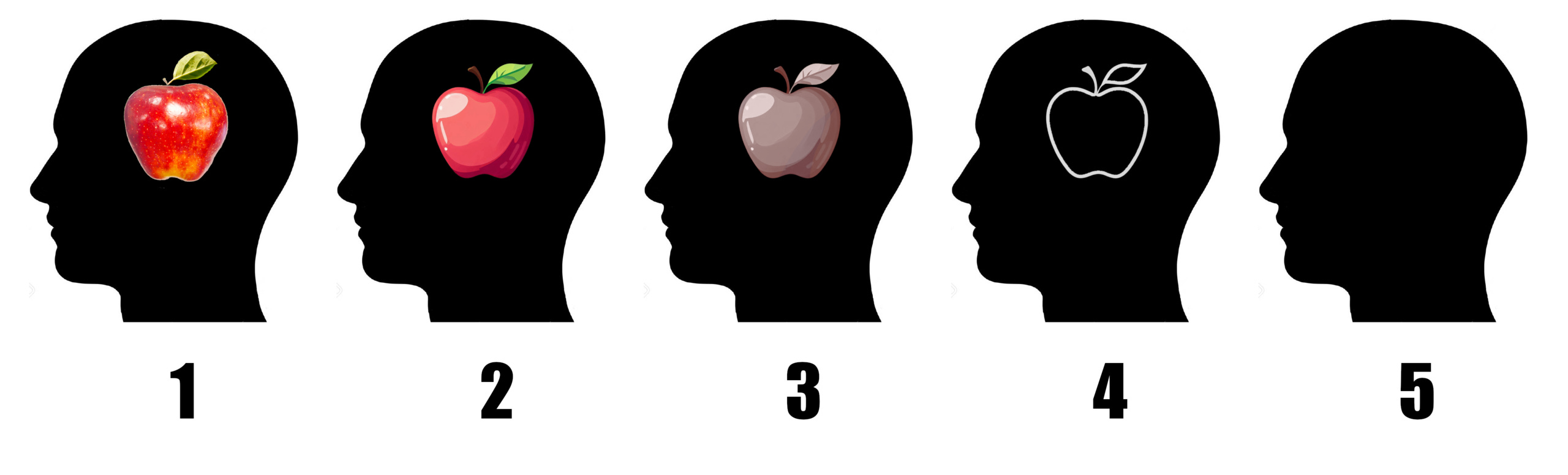
Most people are at level 2-3. Artists are usually at level 1, especially those who can pull their art directly from their imagination. Most writers, I’ve found, are around 2-3, like most of the population.
I am either a 4 or a 5, depending on how familiar I am with what I’m being asked to imagine. Maybe I’ll get to a 3 if it’s something I’m not only extremely familiar with but also have seen recently. If the exercise was to imagine an alien knocking on the door of a spaceship, I would be at level 5, as that’s not something I’ve seen even a picture of to draw on instead.
I realised this also extended to faces when I was watching a crime drama with my husband, and the witness was asked to work with an artist to get a sketch or a composition of the criminal. Fairly standard stuff, right? I said that I wouldn’t be able to do that, and my husband couldn’t understand why. I said even if I was asked to get a drawing of him, arguably the person I am most familiar with, I could list basic features — dark brown eyes, white, grey, and black hair, the hair cut, one earing — but the exact placement of the ears in proportion to the eyes, what shape the lobes are, what shape his nose is. I have absolutely no clue. When it comes to people I’m less familiar with, or I haven’t seen in a while, like my step-daughter, for example, I know even less.
This isn’t prosopagnosia, or the inability to see faces. I can see faces just fine and tend to recognise people by their faces rather than their names, but I just can’t summon an image of them in my mind’s eye at a later date. Certainly not well enough to get a drawing of. Let’s hope I never witness a crime!
This obviously has an effect on my writing. When I was in university, I used to be told I wrote in a white box, and I didn’t really see what the big deal of that was. Who cares if the characters are interesting and doing cool things? Why does where they are even matter? Who cares what they look like?
Turns out a lot of people care! Most people actually.
As I described in my article, The Sculptor Method: Writing Your Novel One Layer At A Time, I start with a basic, bullet point outline of what happens when in the broadest of strokes.
Then I do a detailed outline, or something I’ve come to call a zero draft. It has all the scene beats, who does what, what they feel, maybe snippets of dialogue if they come to me. This is where I start the editing process, after the zero draft. I want to work out any major plot issues at this point, when each chapter is one to two, maybe three pages, but no more.
Once I’m happy with the plot, the characters and their arcs, subplots, all that, then I start my first draft. This is the first time I use proper prose, with full dialogues, tags, and actions. No descriptions, though, unless something in particular stands out to me or some element of the description is important to understand.
Then, finally once my first draft is complete and I have something looking like a proper novel, my first editing pass is methodically adding description. I used to skip this step before I learned about aphantasia, because I figured what was important to me was all the reader needed to know. That was where I would get the white box accusations. Now that I’m aware of this deficit, I know to add it. It still feels bloaty and contrived to me, adding what feels unimportant, but beta readers haven’t criticised it even when I’ve specifically asked about the description and whether it painted a vivid picture or if it was lacking in any areas, so I must be doing something right.
All that to say, if you also have aphantasia, don’t let it stand in the way of your writing dreams! I still managed to not only finish writing a novel, but publish it too, and it has an average of 4 stars across all platforms, which I’m thrilled about as a first novel!
What about you? What level of mental imagery do you have? Let me know in the comments!
You can buy my novel Salt and Ice in ebook, paperback, large print, or read for FREE on Kindle Unlimited for a limited time only.
Want to read more book reviews as well as articles on the writing craft? Subscribe now to get it all straight to your inbox!
If you want to support me and my writing without the commitment of (yet another) subscription service, you can buy me a coffee! And, if you set the same amount as one month’s sub and give me your substack name, I’ll gift you a premium subscription in return! That way you can access all the premium features without the hassle of a subscription.
Very interesting! I'm actually a very visual person so when someone asks me to picture something, it's crystal clear. But the down-side is that I often need pictures/charts to understand concepts, especially if someone is talking at me.
This was interesting to read about! I've always wondered how people with aphantasia can even enjoy reading stories (or especially writing them) without the ability to imagine what they're reading, because to me that's the whole point. But I suppose it is just the visual part you can't experience. If you can imagine other senses and have a 'sense' of the world being described spacially, you're still experiencing the story.
I'm probably a 2 or 3 normally, and can go to a 1 if I'm really immersed or make an effort to visualize something. Strangely though, when I'm reading about people I usually experience pretty much exactly what you've described. Just a vague sense that they're there, maybe a blur of color where they are and their presence. And while writing I intentionally add unique detail about character appearances even though I don't feel like I personally need it, because I know it's important to other people. I can visualize characters vividly if I try to, but for some reason my mind defaults to that blurry feeling.