
The Sculptor Method: Writing Your Novel One Layer at a Time (with sneak peeks from my novel)

When it comes to the writing process, there are generally considered two or three different categories a writer might fall into. You’ve probably heard them ad nauseum before. Plotter versus Pantser versus Plantser.
But this morning I watched a video which broke down the various kinds of writers into more detailed and succinct categories. That was by Heart Breathings and you can watch it here if you’re interested:
While I was watching this, one archetype in particular called out to me: The Sculptor. This described the exact process I have been using towards the end of drafting my novel after much trial and error and what I have decided I will be using from now on.
So, prompted by a conversation with my mum where she didn’t really get how I was going about writing it, I decided to do a quick little article and go into more detail on this Sculptor archetype and how it works for me. Maybe it’ll help you and you might like to give it a try.
Or at the very least you can know what I’m talking about when I use terms like deep outlining in my writing journals.
What is the Sculptor
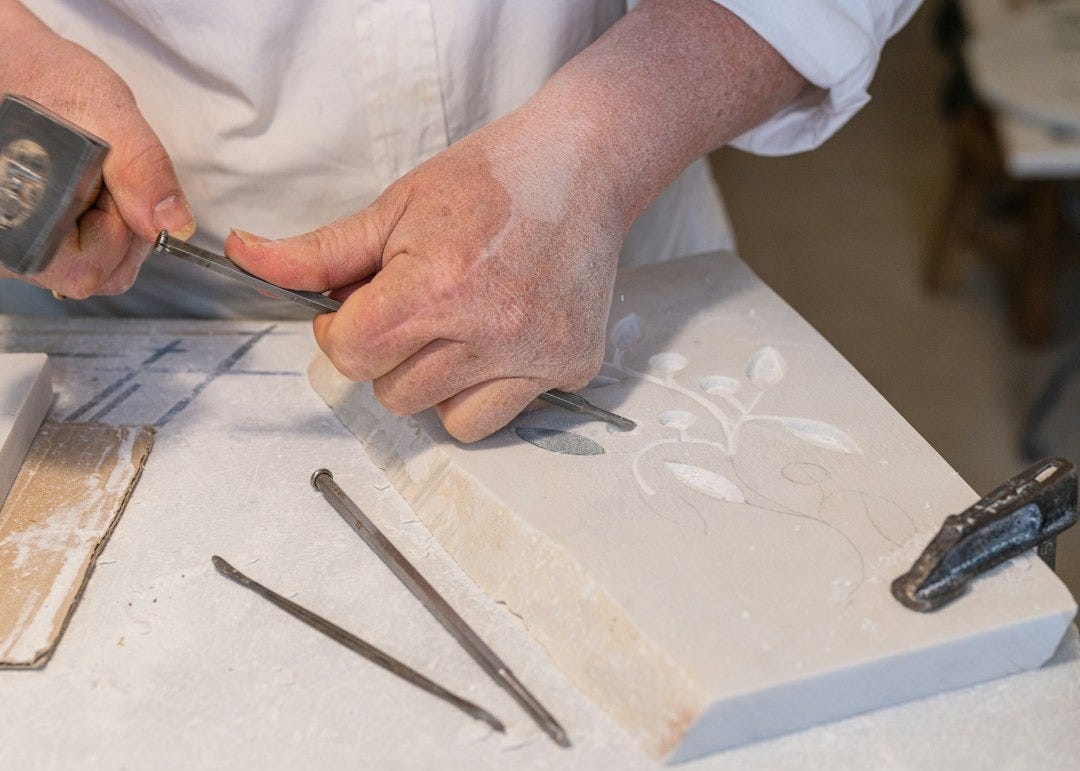
Sara describes the Sculptor as someone who writes in layers. They start with a messy first draft, or a zero draft, often with nothing more than dialogue and a bit of stage direction, then they go back and add dialogue tags, then do a description pass, then an emotion pass etc.
This has the advantage in that it keeps the interest and excitement for the project high as there his visible and impactful changes being made with each editing pass; momentum remains strong.
The downside is the feeling of frustration with constantly dealing with messy drafts or some details remain under developed.
This has described my current writing technique perfectly. I am a sculptor and only just now had the language to describe what I’m doing. So let’s go into the Sculptor way of writing, step by step, and I’ll even include sneak peaks of my novel as examples throughout.
Step 1: Story Structure and Outline
Once I’ve decided what I want to write about (this usually looks like a few characters and a vague plot idea), my first step is to start looking at various story structures. There are so many out there and each of them offer something slightly different. Since I use Lore Forge, it comes pre-built with ten different structures, plus a custom option if none fit so I usually start by clicking through them.
For my novel, I decided that Save the Cat would work best (if you want to know more about Save the Cat, I have just finished my breakdown series all about it with examples, including the novel Luck in the Shadows by Lynn Flewelling and the movie Disney’s Mulan). So I wrote a few sentences for each of the story beats. This is my outline.
As an example, I’m going to use a scene from the Break Into Act 3 story beat. This is the point in the story where things start coming together after the big upset in the Crisis and Dark Night of the Soul story beats. It’s also the only scene that’s had a significant rewrite so far so it will show the passes that it went through.
Daniil POV
Lisa helps him get in contact with an assistant coach of his parents, one his mother mentions in a letter. Hearing of their plight, they catch a flight over and agree to help them with some of the more basic pairs moves.
Step 2: Deep Outline
I’m calling this the deep outline because that’s what I called it in my writing journal. It’s also called the fast draft, zero draft, messy first draft, and any number of other names.
I first heard of fast drafting years ago but it sounded too good to be true. Write an entire novel in a few days or a month tops? Impossible! But definitely something to aspire towards.
From my brief outline of each of the story beats, I then examined it more closely and worked out how many scenes I think it would take. For this story beat, I figured it would need at least three scenes: one where Lisa convinces Daniil to reach out to this assistant coach and ask him for help. One where the coach arrives to help. And one where he is actually coaching Daniil and Mikael.
I then wrote a more detailed, beat by beat outline, or a deep outline for each scene. This example is the last one, where the coach, Yuri, starts to teach the boys some basic pair moves while they’re off ice in the gym.
Daniil and Mik practice before Yuri arrives. Yuri first declares that, for the purposes of this performance, Mik will be the man and Daniil will be the woman. Daniil is not happy about this and protests, saying he’s stronger than Mik. Yuri says that Mik is taller though and height makes the difference. As it is, it will be difficult for them to do the moves when they are only about two inches difference in height, and with the extra weight a man has, but we will do our best, yes? Daniil reluctantly agrees. Mik asks what kind of things did Yuri plan to teach them. A counter-balance lift, a waist lift, and if they can pull it off an assisted cartwheel. He takes a tablet from his bag and loads up videos to show them the different moves. Mik thinks the first two should be easy to do, but he’s not sure about the assisted cartwheel. Can you even do a cartwheel?
This is the first half of the deep outline. As you can see, it’s very messy, has practically no punctuation, no dialogue tags, just blow by blow this happens then this happens then this is said, then this happens. It doesn’t even resemble proper prose, but is more like something a three year old would say when telling you a story of their day.
This does, however, let me know exactly what will be covered in each scene and it’s usually in writing this zero draft that I add scenes or delete them.
Step 3: First Editing Pass
The first editing pass, or the first actual draft, is taking what I wrote in the deep outline and turning it into something that more resembles prose. I add dialogue tags and punctuation, as well as more detailed actions and reactions.
I have mentioned it in a previous post, but something about me is I have mild aphantasia. That means I don’t really have a mind’s eye and I don’t see my stories playing out in front of me like a movie as so many writers do. It’s hard to describe exactly how I experience stories, either those I’m reading or what I’m writing, but it’s not like a movie. It’s more like I can feel what’s going on with my characters and I have a sense of them. You know how when someone is standing behind you staring at you, you can feel it even without hearing or seeing them? That’s kind of like how I experience stories.
Consequently, though, it means my stories lack description and they can be very telling with very little showing. The opening of this scene is a good example of this (and this is kind of embarrassing to share, but here goes):
Mik and Daniil spent most of the last two days going over the choreography of the first two thirds of their gala performance. Even during the open public sessions, there was rarely more than half a dozen people on the ice so it was easy to work around them. Mik had to admit he was impressed with how quickly Daniil was picking up the routine. Since he had been choreographing his own routines for years now, Mik found the memorisation easy, but he had never actually tried teaching anyone else a skating routine. But, as it turned out, Cass was right in saying that if he could teach kids ballet, he could teach Daniil to move with grace on the ice.
He was still awkward and apparently embarrassed to practice any kind of acting, but it was an improvement, and at least he was quick at remembering the moves.
“I really think we have a shot at this,” Mik said after completing another run through of everything they had learned so far. They were both panting slightly but they had performed the whole lot without any mistakes or hesitations.
“We haven’t even started learning the pairs stuff Coach Yuri is going to be teaching us this afternoon,” Daniil said.
“All right, Negative Nancy, be like that. I still think it’s great how well we’ve done. This isn’t a short song; I was expecting it to take longer to memorise,” he said as he took a sip of water. “Did Yuri give you any hint about what he was planning?”
Daniil shook his head and drank some of his own water. “Not really. He did say there would be nothing overhead and no throws though, so that’s something.”
“For sure. You throwing me would just end with me on my arse and me throwing you... well, no offense, but I doubt I’d be able to even get you off the ground.”
“You calling me fat?” Daniil demanded, though he was smirking as he said it.
“Let’s go with muscular,” Mik said, grinning.
Daniil was prevented from saying more when Yuri entered the gym.
“You’re both warmed up already. Good, we can get started,” Yuri said, his Russian accent thick and making it hard for Mik to really understand him.
All of that was built out from the simple sentence of “Daniil and Mik practice before Yuri arrives.”
Step 4: Second Editing Pass
My next step in sculpting my statue, is to highlight all the areas which are, well, bad. They can be bad because they’re all telling and no showing, or they lack description, or the emotion is off or non-existent, etc etc.
In this case, I flagged the first two paragraphs especially as being all telling and info dumping. Not to mention, boring to read. I needed to actually show how Mik was impressed with how quickly Daniil was picking up the choreography.
I created a new revision on Lore Forge (this lets me keep the old version of the scene while editing a new version. This way I can switch between them, like I have for this article, or to prove that it wasn’t actually written with AI since I have all the versions recorded).
“Wait a sec,” Mik called out, hitting pause on the music and stopping. “You’re rushing the transition into that sequence.”
Daniil slid to a halt beside him, his chest rising and falling with exertion. “I thought I had it that time.”
“You’ve got the steps right, just not the timing.” Mik pushed sweat-dampened hair out of his face. “You’re getting ahead of the timing on that one beat.”
“Show me again?”
Mik nodded and skated back into position. He wound the music back a bit, then demonstrated it again, making sure he took his own advice and hit the beats at the exact right moment.
He could see Daniil watching intently, his eyes tracking the timing. Before they started working together, Mik knew that the music was just there to Daniil, background noise for his show-stopping jumps. Now he was not only memorising the routine far faster than Mik could have ever hoped for, he was picking up on musical phrasing.
“Your turn.” Mik said. He wound the music back again and watched with a critical eye.
Daniil completed the transition and the next few moves of the step sequence again, this time holding the beats correctly.
“Perfect.” Mik grinned. “Let’s run through the whole thing one more time.”
They skated back to their starting positions. The rink was nearly empty so they had plenty of room. There was just an older couple making slow circuits around the perimeter, hand in hand. They said they didn’t mind if Mik and Daniil hijacked the rink’s sound system to practice.
The music started, and they moved together through the choreography they’d been drilling for two days. Daniil was still awkward or embarrassed whenever they had to act, and he had to skip over the spins and jumps, but otherwise the routine was coming together. Mik performed all the elements, partially as practice for himself, and partially as a demonstration for Daniil on the timing. When they finished, they were both breathing hard but neither had missed a step.
“I really think we have a shot at this,” Mik said once they reached where he had choreographed up to.
“We haven’t even started learning the pairs stuff Coach Yuri is going to be teaching us this afternoon,” Daniil said.
Now, before you say anything, yes I’m aware of the scene change in this version, and guess what? It’s flagged as needing to be fixed in the next revision pass! But I think overall this opening is much stronger.
Step 5: Etc, etc, etc
I can only really go up to here with the examples, since that’s as far as I’ve gotten in revising my novel, but I think you get the picture. The next pass will be fixing inconsistencies like what I just mentioned, and also reading it as a reader and seeing if there are parts that are boring or not well explained, or just plain lacking.
I don’t know how many drafts or passes it will take, but there will probably be at least two or three more until I’m happy.
Final Thoughts
What do you think of the sculptor style of writing? Does it sound like something you do or maybe something you’d like to try out? Let me know in the comments!
Want to support me and my writing endeavour, but don’t want the hassle of managing yet another subscription service? I’ve got you covered! Buy me a coffee for the same amount as my monthly subscription, drop your SubStack name in the comment, and I’ll gift you a month’s sub. Same good value, none of the stress!
I saw this video and realized I’m a sculptor too. Actually, a hybrid, but the sculptor aspect is dominant. I wonder if it evolves as you grow as a writer.