

Note: I stuffed up. This was supposed to come out before the Spins article, so if you were a little lost about the anatomy of the blade, then hopefully this will explain things a little better.
The jumps in figure skating are, perhaps, the most iconic part of the sport. They are also the easiest element to tell if an athlete performs them well. If they fall: bad. If they land cleanly: good.
But when it comes to knowing the difference between the different jumps, that’s where things get tricky. This article will break them down for you, but even with this handy dandy guide, don’t worry if you still can’t spot them live on TV. It takes a lot of practice and focus to distinguish between them. Still, with this, the terms won’t be completely foreign to you.
Before we go into detail on this though, I need to explain blade anatomy. A figure skating blade has four main parts.
Blade Anatomy
The toe pick
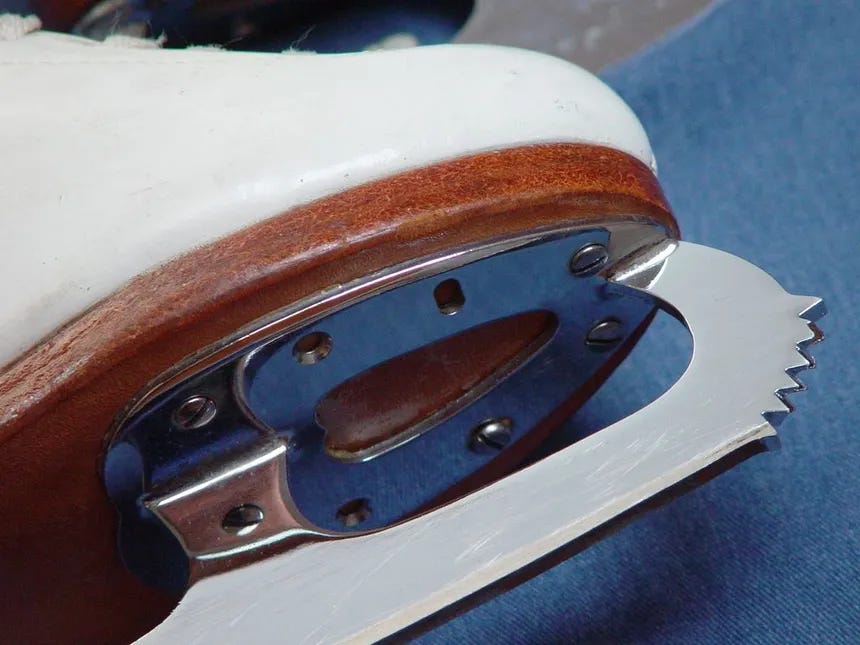
If you’ve ever seen the movie The Cutting Edge, you’ll know all about the toe pick. It’s the grippy bit of the blade at the toe. It’s used as a pivot, to aid in some jumps, and to trip up unsuspecting hockey players who think they can figure skate.
The rocker
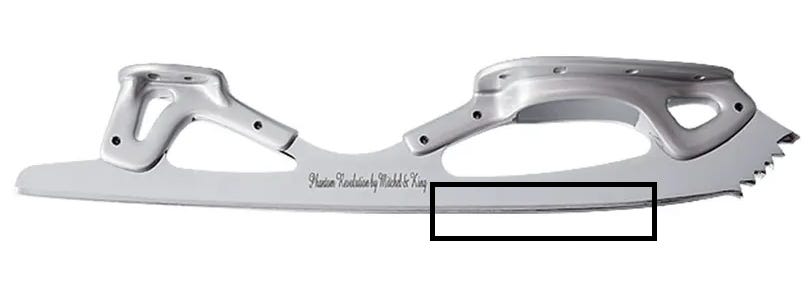
Contrary to how they look at a distance, figure skating blades are not flat to the ground. They have a gentle curve and the point where the blade is curved is called the rocker. Figure skaters position their weight at different points along the blade in relation to the rocker to perform different moves.
Edges
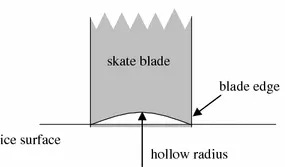
Even though the blade looks like one piece of metal, it’s actually got two edges. The hollow is small, but important when it comes to correctly performing skating skills.
The inside edge
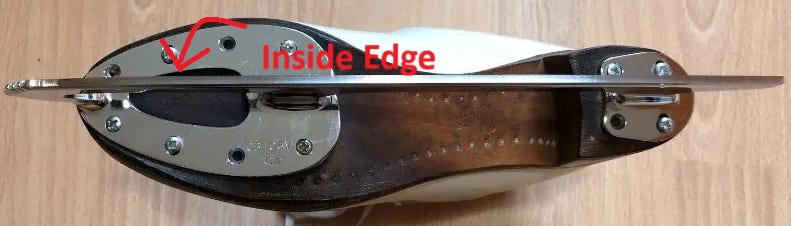
This image is of a left boot, so the inside edge is on the right hand side, or facing the inside of the body. If a skater is on their left foot, they use their inside edge when travelling in a clockwise direction when travelling forwards, or anticlockwise when travelling backwards.
The outside edge
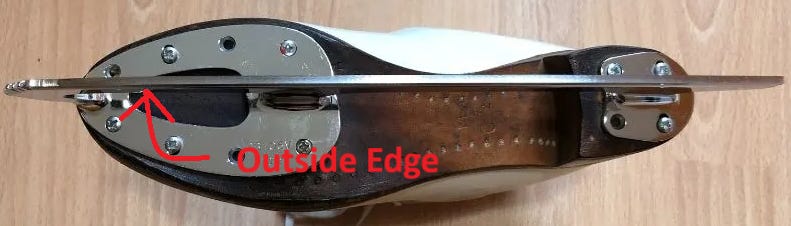
Again, a left boot, so the outside edge is on the left hand side, or facing away from the body. If a skater is on their left foot, they use their outside edge when travelling in an anticlockwise direction when travelling forwards, or clockwise when travelling backwards.
Right, now that that’s out of the way, let’s get to the jumps!
Toe Loop (T)
Even though the video is the same for each of the jumps, I have bookmarked it at the right time for that particular jump.
The toe loop is one of the easier jumps and, as such, it’s often added on as a second jump in jump combinations (more on that below).
The skater is travelling backwards on the outside edge of one foot. They then slam the toe pick of their free foot into the ice and use that to launch them into the air. They then rotate the required amount (between one and four times), and land on the outside edge of the same foot they took off on.
So, backwards outside edge, toe pick assisted jump, land on the same foot, outside edge.
The base value for a single toe loop is 0.40 points. But in elite competition, the single jump is usually not allowed, so will score 0 points. Instead there is a scaling score based on the number of rotations.
Salchow (S)
For the salchow jump, the skater is travelling backwards on the inside edge of one foot. They then jump without the toe pick, rotate the required amount, and land on the outside edge of the opposite foot of the one they took off on.
So, backwards inside edge, no toe pick, land on the opposite foot’s inside edge.
The base value for a single Salchow is also 0.40.
Loop (Lo)
The loop jump has the skater travelling backwards on the outside edge of one foot. They jump without the aid of the toe pick, rotate the required amount, and land on the outside edge of the same foot.
So, backwards outside edge, no toe pick, land on the same foot’s outside edge.
As you can see, this is the same as the toe loop, just without the toe pick assist. However, because the use of the toe pick makes the jump easier, a single Loop jump is awarded 0.50 points.
Flip (F)
The flip starts with the skater travelling backwards on the inside edge of one foot. The toe pick is used to assist with the jump, then rotate the required amount, and land on the outside edge of the opposite (the toe pick using) foot.
So, backwards inside edge, toe pick assist, land on the opposite foot’s outside edge.
As you can see, this is the same as the Salchow, but with the toe pick assisting. However in this case, adding the toe pick take off adds complexity to the jump. As such, the single Flip is awarded 0.50 points.
Lutz (Lz)
The lutz jump begins with the skater travelling backwards on the outside edge of one foot. The toe pick is used to assist in the jump, then rotate the required amount, and land on the outside edge of the opposite (the toe pick using) foot.
So, backwards outside edge, toe pick assist, land on the opposite foot’s outside edge.
This is considered the most difficult and technically demanding of the jumps that are performed while travelling backwards. As such, a single Lutz jump is awarded 0.60 points.
Axel (A)
Now, this video is a few years old so Jason Brown’s comments about the quad axel not having been done is no longer accurate.
This is the only jump that starts while travelling forwards. The skater begins on the forward outside edge of one foot. They do not use the toe pick for this jump. They rotate the required amount, which is always half a rotation more than the number (so a single axel requires 1 1/2 rotations, Ilia Malinin’s quad axel (the only person to land it in competition as of this article) requires 4 1/2 rotations). Then they land backwards outside edge of the opposite foot.
So, forwards outside edge, no toe pick, an extra half rotation, and land on the backwards outside edge of the opposite foot.
The Axel is widely considered to be the most difficult of all the jumps, partially because it is the only one to launch while skating forwards when most skaters learn to jump while skating backwards, and also because of the extra half rotation it requires. As such, a single axel is awarded 1.10.
As an aside, the ISU have decided that the ultra rare quad axel is to be awarded a whopping 12.50 points (1 point more than the quad lutz).
Combination Jumps
In elite competition, there needs to be at least one combination jump performed. This is one jump, followed by another, sometimes separated by an Euler, or a half loop.
The ending edge of the first jump should be the starting edge of the second one, and the second is usually assisted by the toe pick.
For example, a Toe-Toe is a combination jump, or it could be a Lutz-Toe. Because the lutz ends on an outside edge and the toe starts on the outside edge, one naturally flows into the other.
If a skater ends on an outside edge, and wants to add a flip or, more commonly, a salchow as the second jump, they need to change edges. They do this with a half jump called the Euler. This actually looks like a mistake if you see it in competition. It looks a little like a skater has stumbled or messed up a jump (and personally, I don’t like how it looks because of that), but it is a legitimate way to switch the edge in preparation for the second jump.
Adding an Euler adds an extra 1 point to the combination jump, and allows for more interesting and higher scoring combinations.
Final Thoughts
So there you have it, a basic run down of the single jumps. If you’re reading this after 2025, then it’s possible the scores may have changed but, to my knowledge, they are correct as of the time of writing. And the jumps themselves are not going to change.
Any questions? Drop them in the comments and I’ll do my best to answer!
Want to know what prompted these articles and all this reasearch? My debut novel Salt and Ice is coming out in less than 2 weeks! You can preorder now from Amazon or my website for a signed copy if you live in Australia.